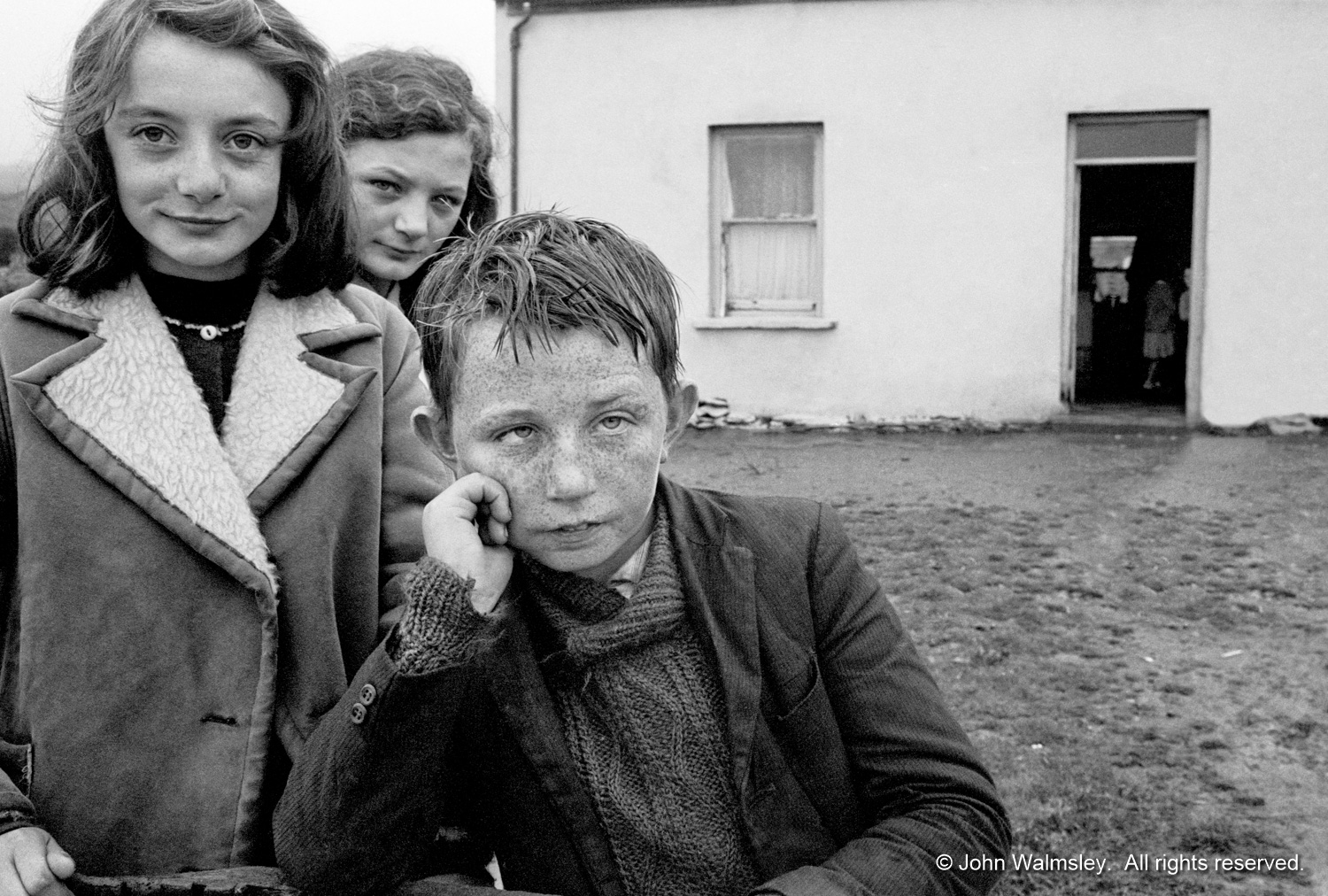
Gyorgy Laszlo: I believe that we are drawn to images even before we take them. What drew you to this image of the three children in Dunquin?
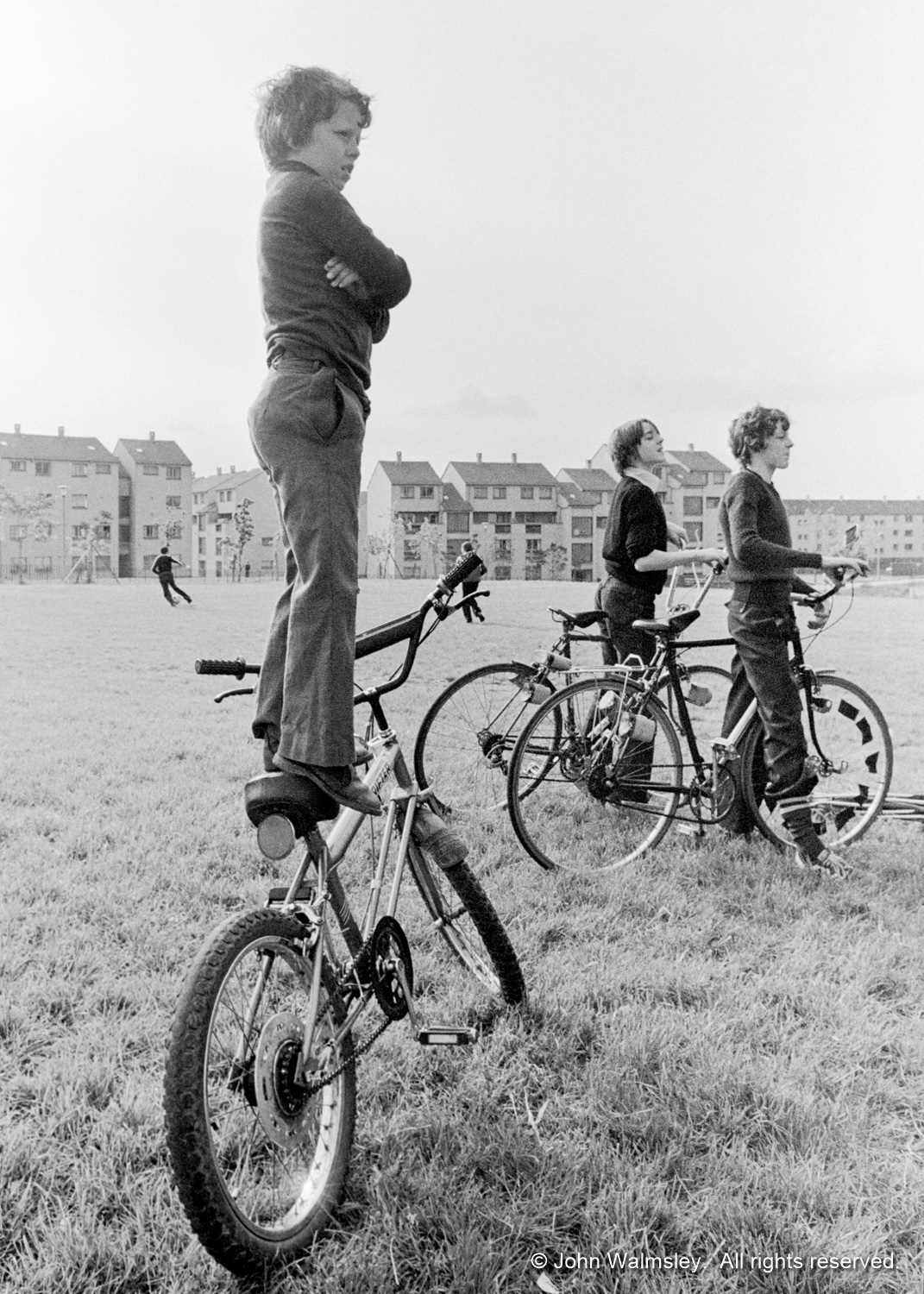
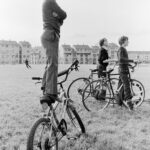
John Walmsley: It was 1967, the holiday between my 2nd and final years at Art School. A pal and I were hitching around southern Ireland and came to the small farming community of Dunquin on the tip of the Dingle peninsula.
That morning I left the tent and wandered around the village. These kids saw me and came out of their house to chat. They stood exactly as you see them. I did not arrange them in any way. We chatted for a few moments, I took a few shots and then continued my wandering.
Since uploading the images to my website, I’ve heard from people who either had lived there at the time or had relatives in the photos. They now have prints and have been able to share stories with me.
Documentary photography is always about walking a fine line between the photographer’s right and creative need or desire to record an image and the subject’s right or wish to be or not to be photographed. What do you think about the often unspoken contract between you and your subject?
There’s one question I keep in mind when out shooting strangers. Even if I have the legal right to take their photo, would it be a good idea?
If someone made it plain they were not happy when I raised the camera, I would stop and talk to them. For me, it’s up to them if any photos are taken. I know some street photographers never speak to their ‘subjects’. It’s shoot and move on. I’m very happy to chat. I like chatting to people.
I am more of the “shoot and move on” person. I often find that when you talk and then shoot people will start behaving in front of the lens. And that the “essence” of what you saw starts slipping away.
Yes, it can change things but, if they see you and the camera and you don’t go chat, then that also changes things and usually not in a good way. They wonder who you are and what you’re doing and can easily become wary.
Photography, like any creative activity, can mean so many things to different photographers. Is photography an end in itself for you or perhaps a means to meet people and to experience parts of the world that you otherwise wouldn’t visit?
It enables me to enquire and then describe, in my own terms, what I find. I’m most interested in ordinary life so would photograph anything where I think I could capture its essence. Also, it’s most useful when helping others succeed and do something they’ve not managed before, where the activity is more important than the photos.
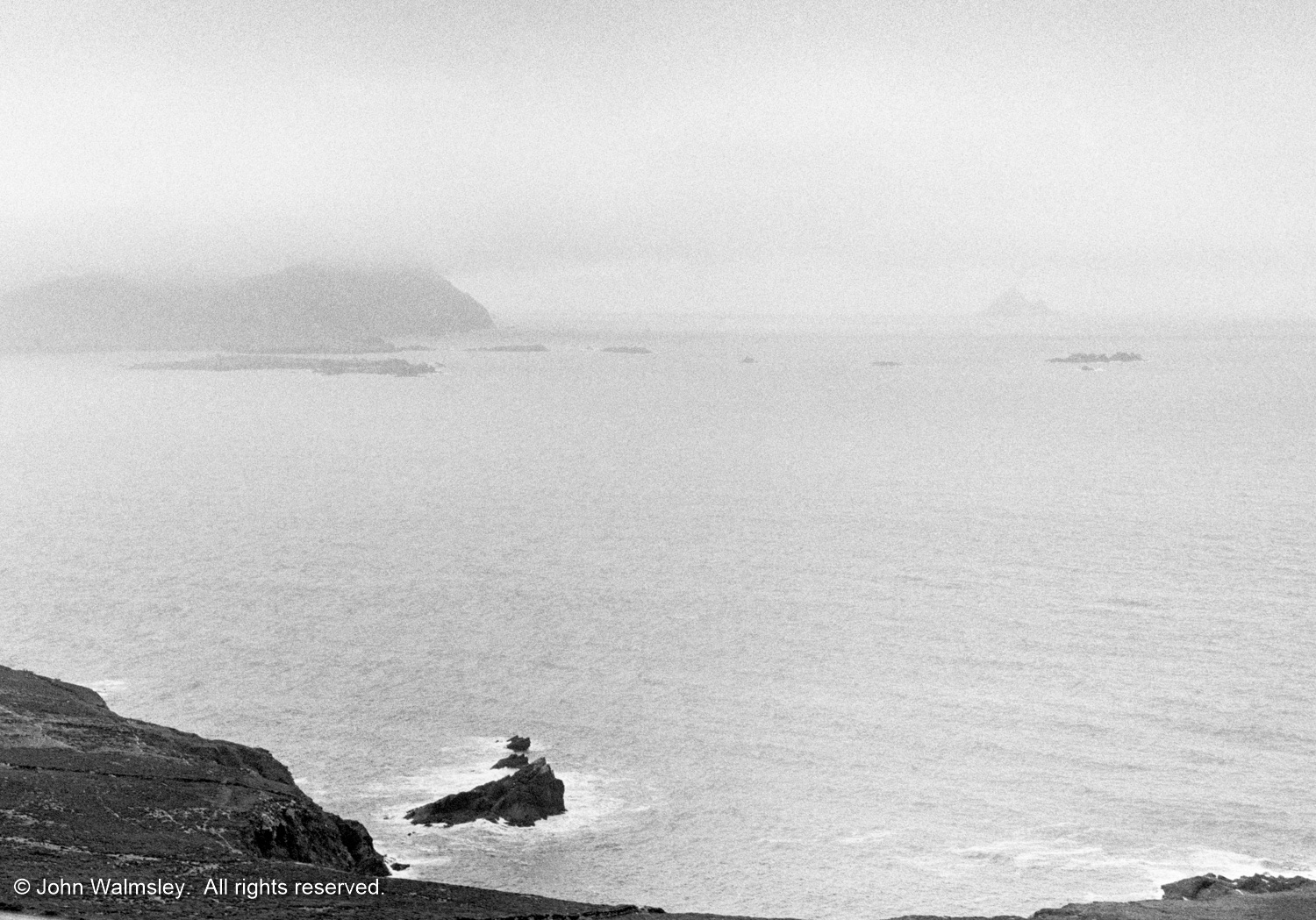
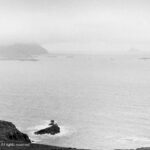
Looking at this grey, misty Irish landscape the word that springs to my mind is ‘fragility’. There is almost nothing to see. Even the attempt to have taken this photo is an act of gentle fragility.
Landscape photography is like people photography in that you have to work hard and be lucky, too. It’s the combination of the two which makes it happen.
My non-people photos just come about as I go along. For some years in the 70s I was a part-time lecturer at the Architectural Association School of Architecture in London. I noticed that students took photos of buildings with no people in. OK, there was a good reason for that but I thought, if the buildings are not about people, what are they about? So, I gradually, persuaded them to shoot both with and without people. A small change on the surface but a significant one which I hoped would inform their future careers. It’s the people who matter.
I like people and the stories they have to tell. Many people do not get much of a chance to talk, to talk about themselves. I get better photos if I leave space for the subject do that.
One of the most enjoyable experiences is when someone, a normal person not a celebrity, says, ‘That is the best photo anyone’s ever taken of me’. It may not be a prize-winner but it has changed a person’s feeling about themselves. They’re happy and proud to show it off.
That’s priceless and is something photography is in a unique position to do.
Your career spans the transition from film to digital. How did you take that transition? How long did it take you before you embraced it?
My transition was slow. New digital cameras were expensive and, as I’d always worked in educational publishing and for government departments, budgets had always been limited and I didn’t have spare cash.
As a student, I remember working in the darkroom and thinking we’d been using wet chemicals in trays for the last 150 years and that there simply had to be a better way. When my kids were young and we had a small digital camera, we would walk on the heath and I was no longer the awful dad saying, “That’s enough photos of that bush/tree” or whatever. They could just shoot and let it flow. It was a great release. I don’t miss analogue one bit.
At art school I had a Minolta SLR and then a Leica and then moved to Nikon which I used for decades.
I stopped using the Leica because too often the difference between what I saw in the viewfinder and what the lens captured, especially when close to people, was just too much. Things that lined up perfectly in the viewfinder, did not on the film. That prevented my getting the images I saw.
They all became big, heavy and noisy so I was delighted to win a Fuji mirrorless body in a competition and have used that system ever since. They are much smaller, lighter and, crucially for some of the sensitive work I do, special needs or actors in rehearsal, silent.
Every day I carry a body with an 18-135mm zoom lens which I think gives me the best chance of catching whatever ‘moment’ comes along. I do some street photography and have recently been looking at what the professional street photographers use and mostly see beautiful camera bodies but with a fixed prime lens. That wouldn’t work for me.
I would not be using the longer end of the zoom in order to keep back. I like being in amongst the people. But, there are so many photos where the framing needed cannot be achieved with a wide prime. Again, that would prevent my getting what I had seen. I think it’s a matter of each tog deciding which set of circumstances works best for them.
I feel that first we have been flooded by photography and now we are being flooded by moving images on social media. I consider it a form of visual pollution. What do you think about the role of photography today?
I am greatly concerned for anyone starting out. How they are supposed to make a living is beyond me. Rates are appallingly low and people try to take advantage at almost every turn. I offer a talk (on Zoom) called ‘Getting Your Ducks in a Row’, which is about being business-like from the beginning so that you can protect your copyright and deal sensibly with clients who try to grab more rights than they’ve paid for.
All creatives struggle to pay the bills. Why is this? Largely because society does not place any monetary value of art. For instance, schools expect to pay for books, staff salaries, equipment, insurances, light & heat etc. but not for the use of photos in teaching situations. OK, there are exceptions but this is the general position. It makes no sense and we need to challenge it at every opportunity.
Social Media has definite benefits, no doubt. But I wonder why so many of us seem to have abandoned our critical faculties and ignore the real and serious downsides to posting photos of people on social media.
The way these sites have treated young people, especially vulnerable teens, is truly awful in my opinion. You just have to read what the Children’s Commissioner says to know she is greatly worried by the whole situation. How have we arrived at the situation where a teenager sees their worth in terms of ’Likes’ and comments on Social Media?
John also offers a talk (on Zoom) called ‘Getting Your Ducks in a Row’, which is about being business-like from the beginning so that you can protect your copyright and deal sensibly with clients who try to grab more rights than they’ve paid for. In case you’re interested get in touch with him via his site.
We use cookies to ensure that we give you the best experience on our website. If you continue to use this site we will assume that you are happy with it.