Gyorgy Laszlo: Looking at your huge library of photos made me think about the question of context. Personally, I am really attracted to photography that needs no or minimal contextual information for me, the viewer, to understand it. Context, naturally, always deepens appreciation. However, there is a simplicity to images that talk about the human experience in more universal terms.
David Hoffman: I rarely make photos about individuals. As a photographer I’m not really interested in individuals or even the specific event. For me they are meaningful or illuminating components that I assemble to make my image. I try to frame and time my photographs to show underlying issues, not specifics. I am using the people and the event to make a more general issue visible.
This can reasonably be seen as a lack of respect for the real human beings that I’m photographing. Of course, they have their own views and they are there for their own purposes but I’m consciously dismissive of that. I use them to make my own statement about the issue. I do not see an approach based on specific consent as having a place in honest reportage.
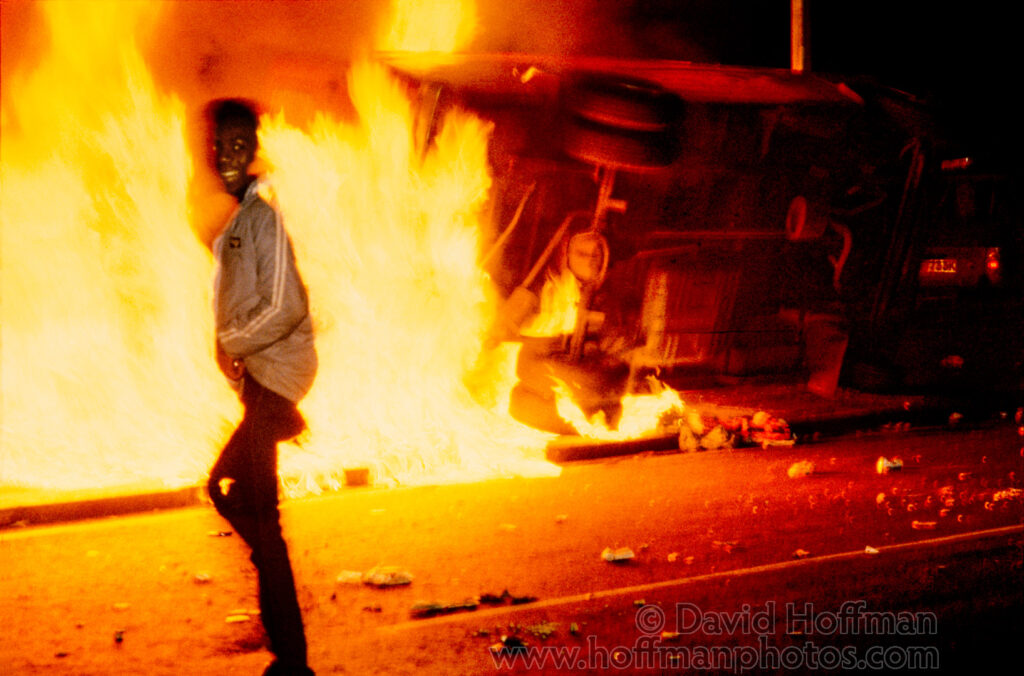
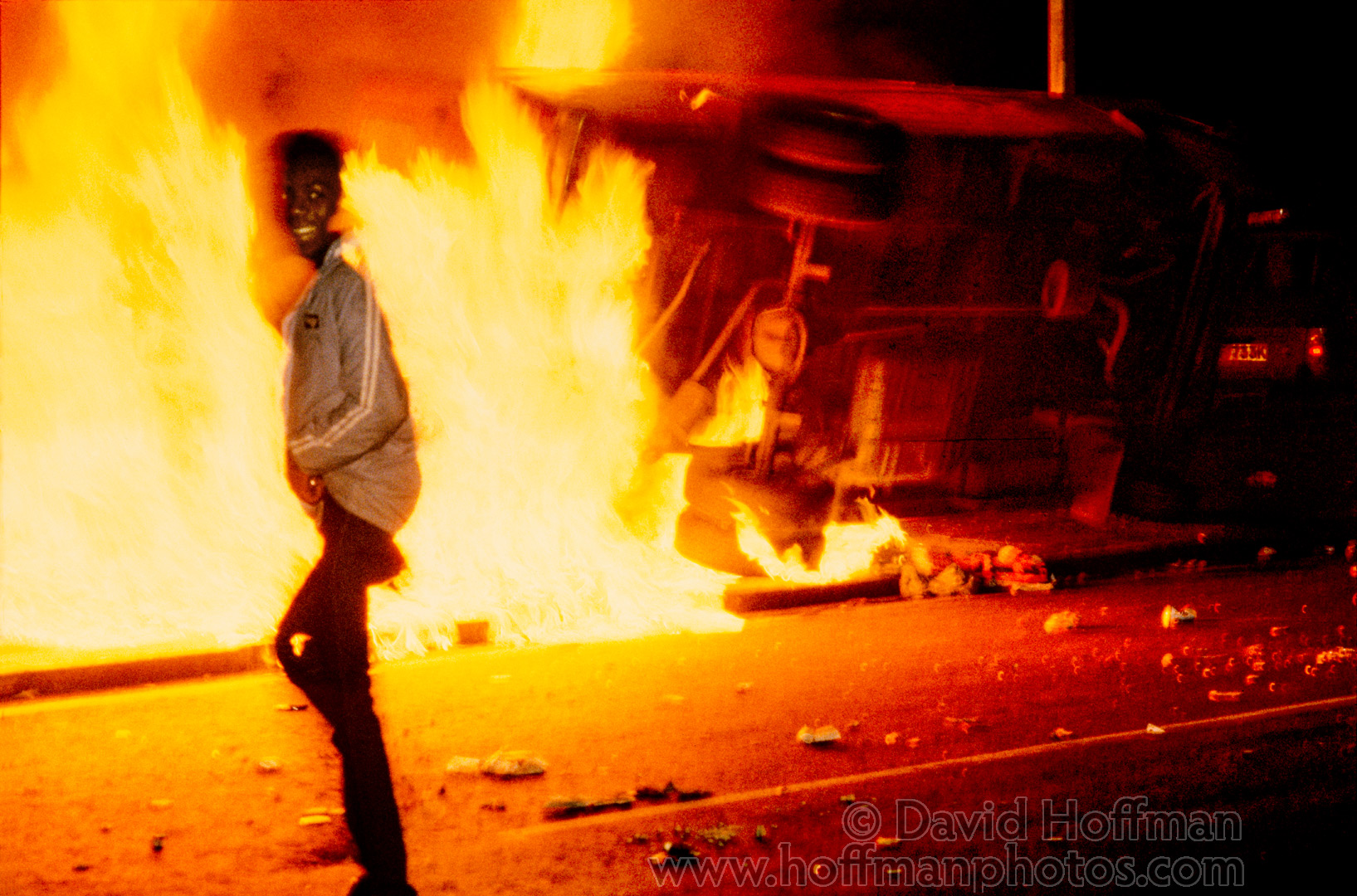
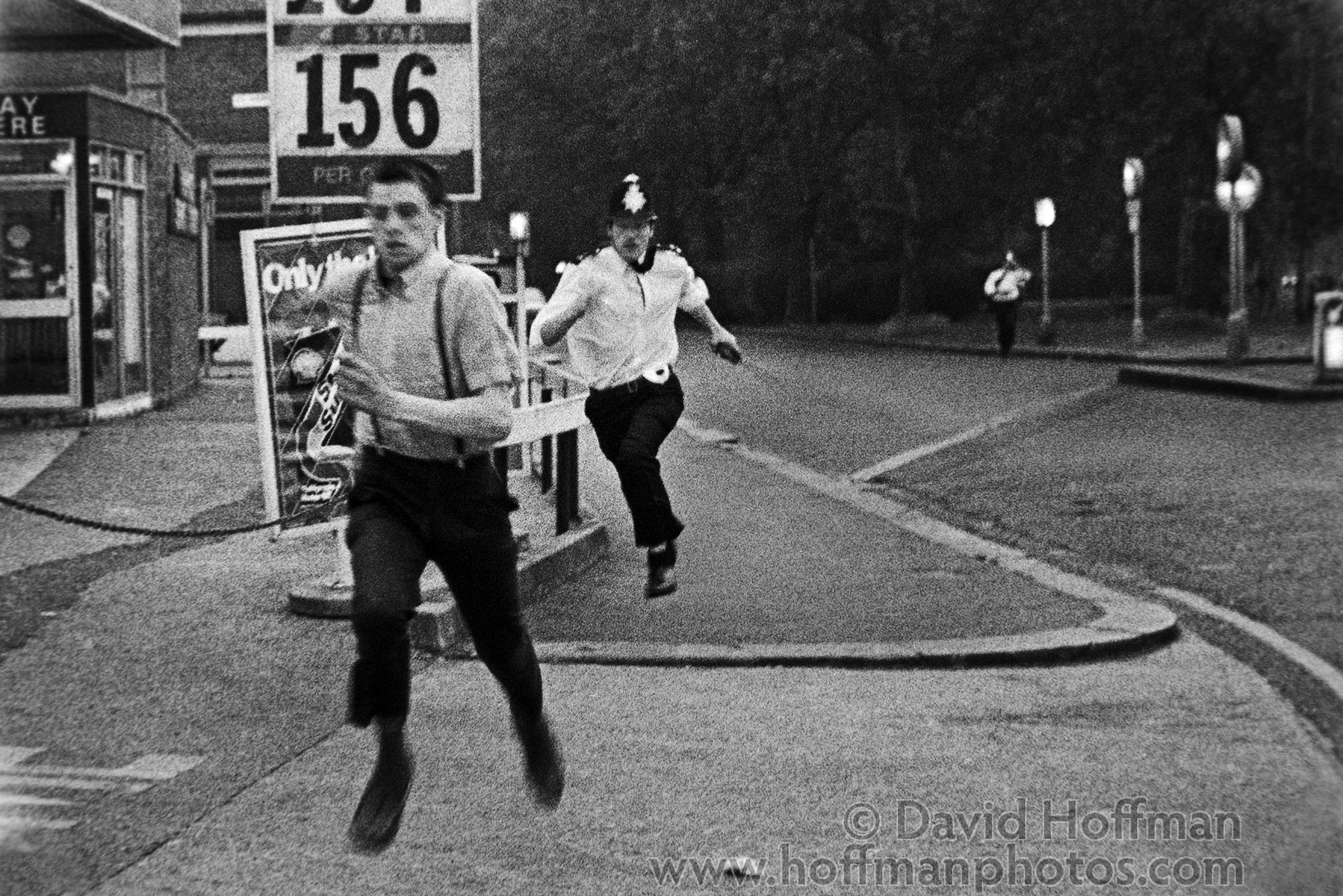
BRIXTON YOUTH RUNS BY FLAMES, 1981.
How important is it for the viewer to know about the context of your photography?
Knowing the context is very important in documentary/reportage pictures. There are plenty of examples where the absence of context has allowed a false meaning to be attributed.
The youth running past flames is from the 1981 Brixton uprising. It does work as an image without context but knowing that it was in a police-generated riot reframes it. It would be easy to add a caption “Arsonist runs from house where family died”. Or “Looter flees police in London riot.” Adding the context is necessary if such dishonesty is to be prevented.
The tools photographers use for creating their images provides a different kind of context, one that I often find equally informative. You have both colour and b&w images from the Brixton riots. What kinds of film were you using?
At that time, I’d generally have been using a mix of Tri-X and occasionally 3200 ISO Recording Film for BW. Ektachrome 200, 400 and 800 for the colour plus a bit of that awful 3M ultrafast transparency film for the darkest corners. The quota would have been however much film I had or, occasionally, could blag from a colleague. I always carried a lot (20, 30 rolls or more) and I shoot generously so 10 – 20 rolls on a big demo wasn’t unusual.
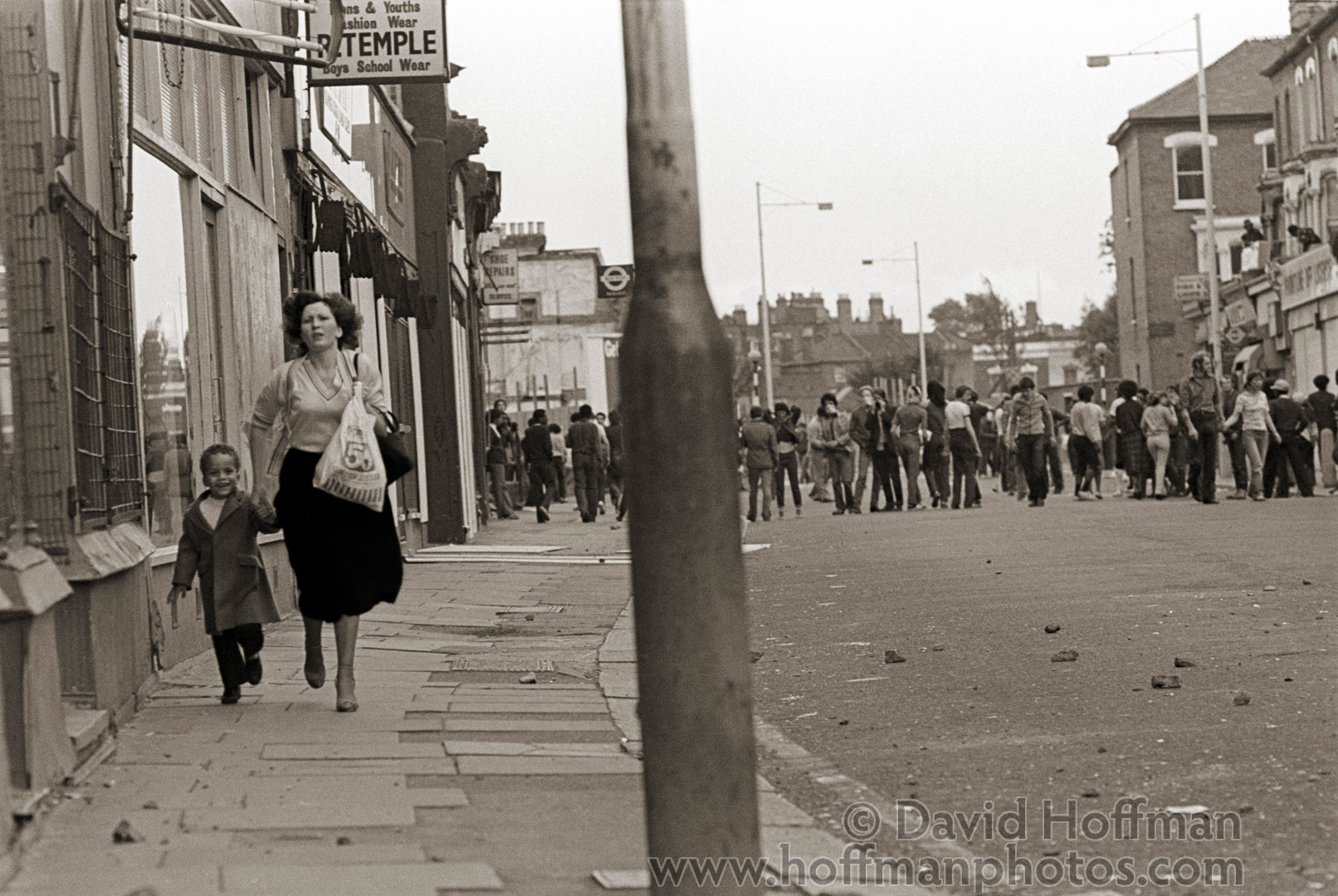
WOMAN RUNNING, BRIXTON RIOTS, 1981.
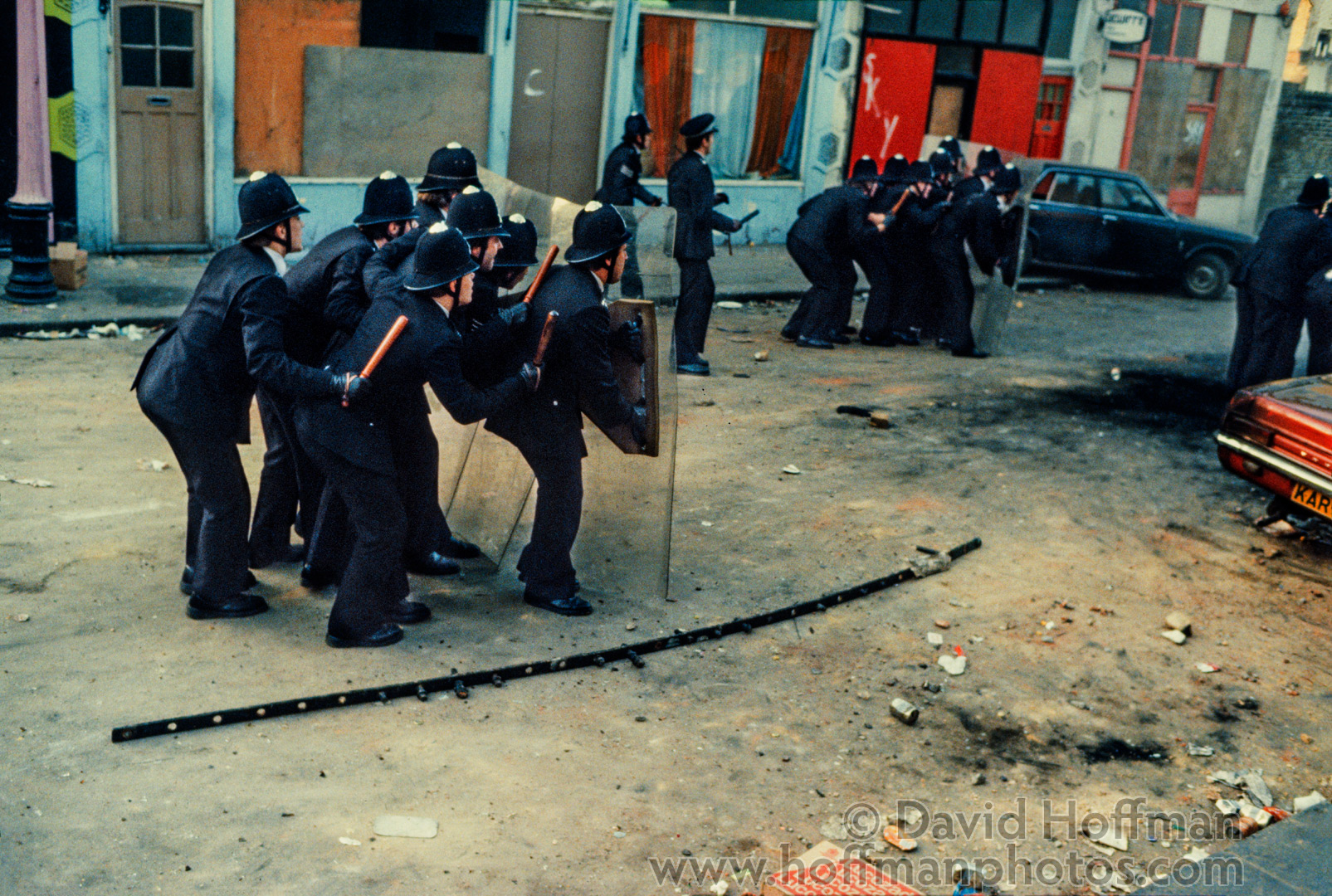
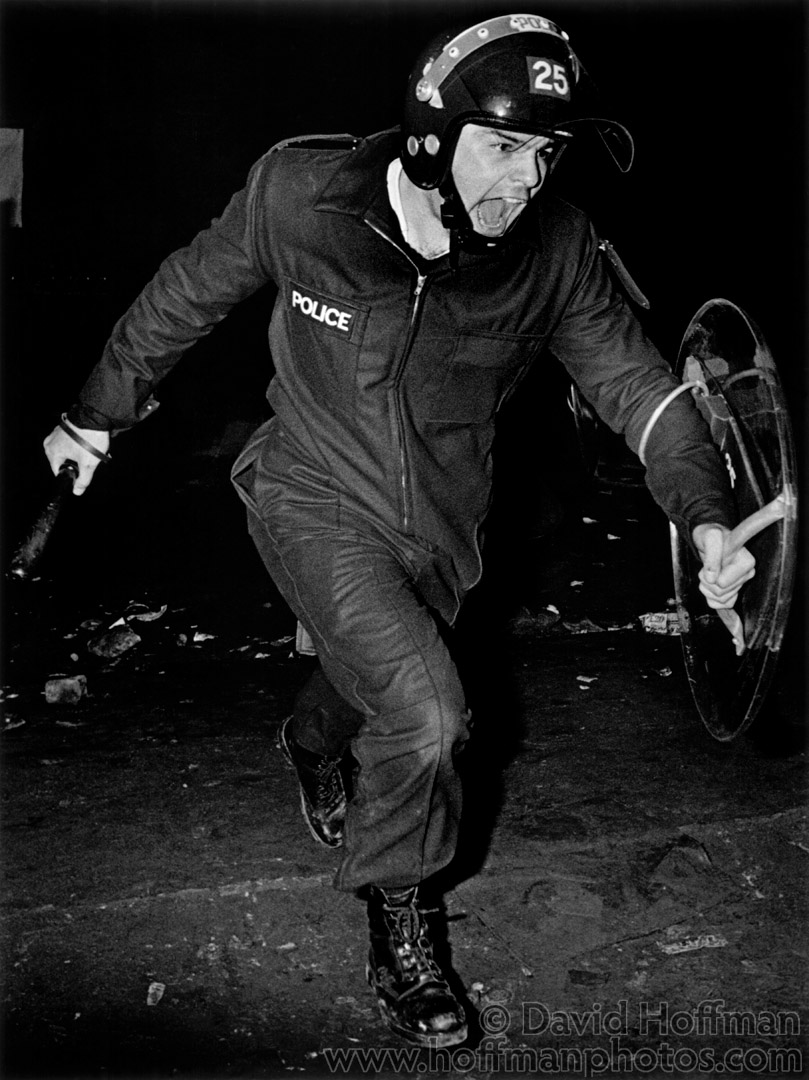
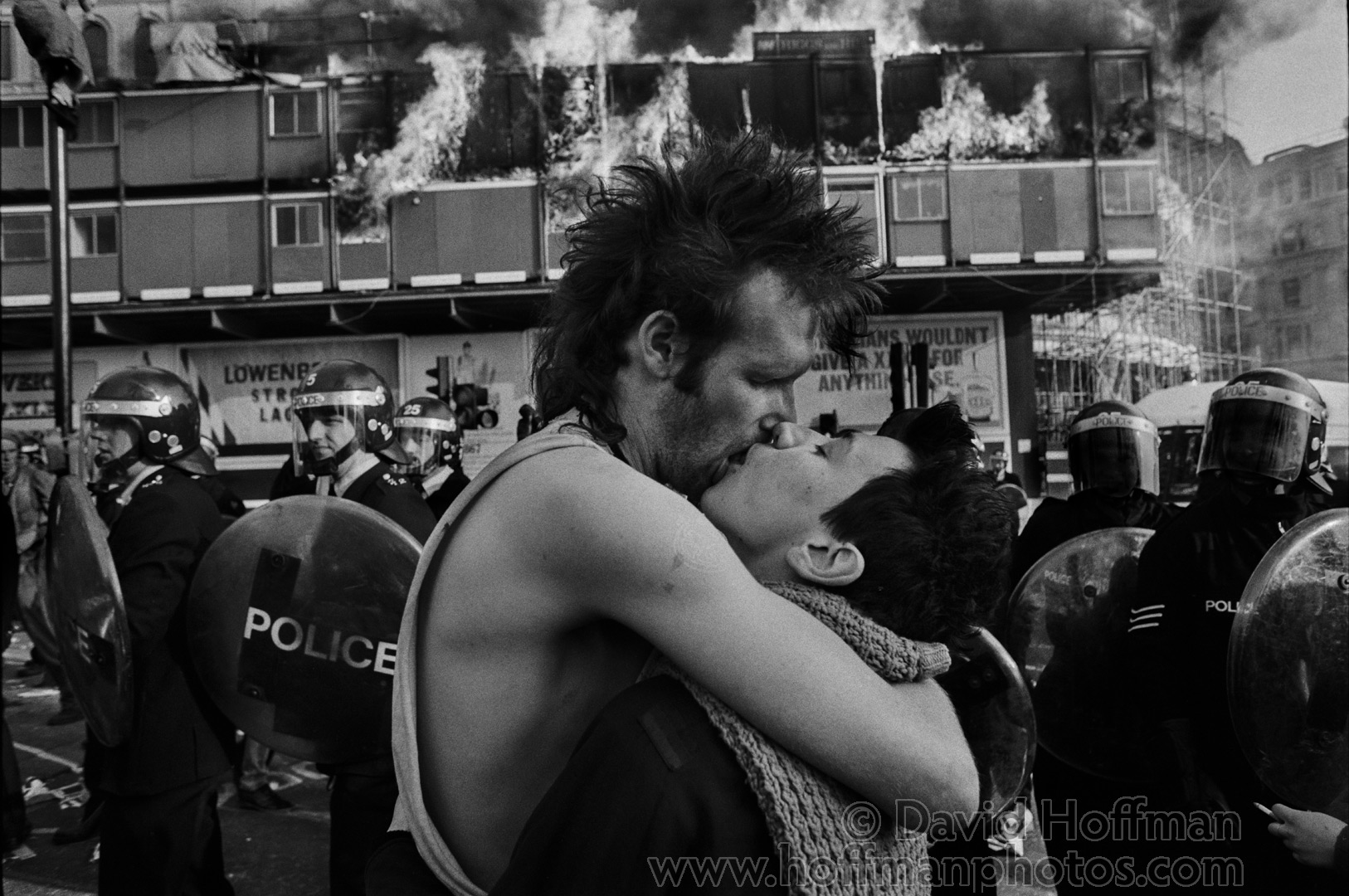
BRIXTON RIOTS, 1981.
How many and what kind of cameras did you shoot with? More importantly, what lenses were/are your favourites?
I think I still was using a couple of Nikon F bodies then. I don’t think I moved on to the F3 until ’82 or’83. I’d mostly have used the 24/2.8, 35/2 and a 200/4. I also had a 50/1.4 and a 105/2.5 but they’d have been less use here. The 24 was the widest I had but later, when I could afford it, I got a 20 and then, with digital, the equivalent of an 18-35 zoom that I use a great deal, mostly at 18.
How did you find your exposure?
The metering on the Nikon was pretty good and I’d always base my exposure on that but then I’d increase/reduce exposure depending on the scene and whether I was shooting BW (try to keep the shadows) or tranny (try to keep the highlights).
This was my first riot but I’d been working full time for 5 years so I was OK with working the kit on autopilot. Adjusting exposure would take less than a second, just a twist of the aperture to move the meter needle in the viewfinder over to one side or the other to compensate for bright flames or to avoid overexposing a dark scene.
On the technical level: how did you manage the enormous difficulty of focusing in the dark through an optical viewfinder?
Practice, good night vision and just instinctively knowing how far to turn the ring for the distance. It’s easier with a 24 and of course nobody gets to see the out of focus shots!
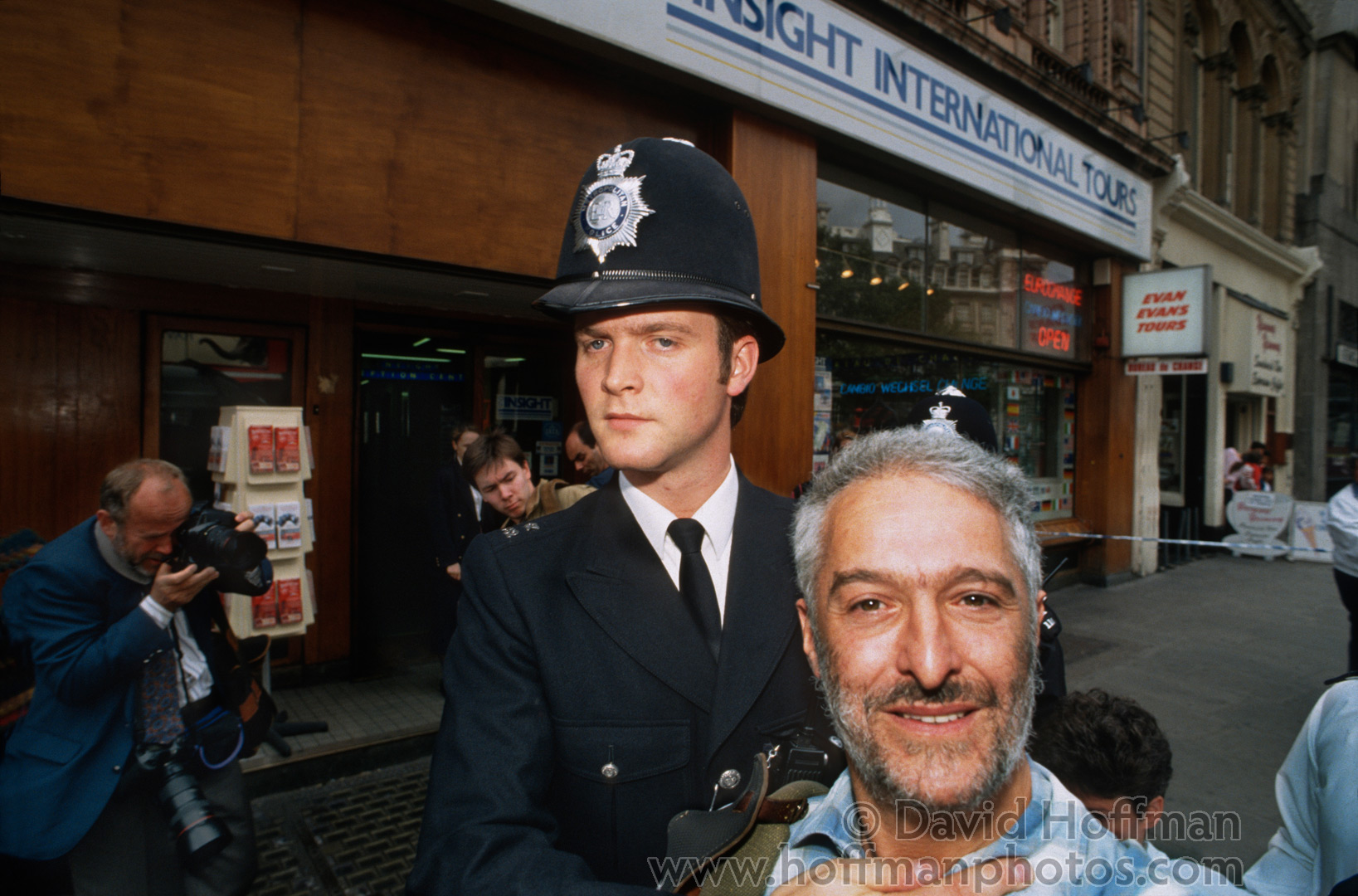
UNLAWFUL ARREST OF KIERAN MOYLETT BY SERGEANT "BERT" WEEDON ON THE STOP THE CITY DEMO, LONDON 29 SEPTEMBER 1983.
Let’s delve a bit deeper into context. The full caption of the above image says:
Unlawful arrest of Kieran Moylett by Sergeant “Bert” Weedon on the Stop the City demo, London 29 September 1983.
That’s a good example of where, not knowing the context, the viewer feels that they know enough of the story from the image they see. We humans are very prone to believing that what we don’t see doesn’t exist. There is a great deal of background to that image which changes and adds to the viewer’s understanding. Moylett had just photographed Weedon strangling another demonstrator. Moylett was acquitted and paid compensation by the police.
Within your personal context of that day, when and how did you take it?
I got there around 7:00 in the morning (it was an unusually early demo) and stooged around trying to be inconspicuous, staying near to where the protests and the police were close to each other. The action was sporadic and spread over a wide area so I didn’t get to shoot much, about 4 rolls.
How long did you shoot that day?
By midday it was pretty much over as I recall. Still a handful of protesters but fast moving and dispersed. Not much opportunity for me to get useful images.
NEWS INTERNATIONAL STRIKE, WAPPING, 1986.
You have covered lots of demonstrations, plenty of violence and yourself have been a victim of police brutality. You are drawn to capturing violence. Yet, from the videos I’ve seen of you, you come across as a mild-mannered, but no-nonsense person.
You write as though there was a contradiction here. I experienced an excess of violence in my childhood and that’s probably got a lot to do with the direction of my work but I don’t see that this need lead to me being aggressive. I may be trying to show myself that I can be safe in violent situations. I may be trying to confront violence to reduce my fear of it. Maybe I just find it exciting and a satisfying way to earn a living.
I’ve no idea if any of these are the case but it’s worth noting that I’ve never been attracted to real violence as in war photography. It’s how our own social pressures clash with the state that I’m interested in.
When photographing violence, there must be an adrenaline rush. How do you deal with it? Do your instincts of self-preservation kick in at some point? Or is your curiosity too strong to prevent you from going closer and closer?
There was a lot of adrenaline when I first covered violent events. That makes it difficult to produce good work or to stay safe. With more experience I’ve found it easy to remain calm and attentive to my surroundings.
It can become quite meditative and Zen. There’s a lot to keep one aware and focused. Apart from keeping the cameras working properly – checking settings, battery, film/memory etc – one needs to see the ebb and flow, where people/police are massing, what their likely movements are, where your colleagues are, where those who might attack us are, keeping one’s exit strategy current and more.
All those things need to be attended to unconsciously so as to leave headspace to actually do the job of looking for, framing and grabbing well-made images and then getting them away intact.
During your career film got replaced by the memory card as the mainstream recording medium of photography. How has that changed your photography?
I’ve always shot a lot, film and digital. I’m a bit hair trigger. I grab the shot before I’ve really judged it. It’s an almost preconscious act. Judging what to use is for later.
The main difference for me with digital is that I can push the technical limits further. With film I’d need to be sure I was getting the image but with digital I can shoot in ways that are on the edge of what might work and immediately see if it’s OK or what I need to change.
Another bonus with digital is with moving subjects in poor light. I’ll sometimes use a slow shutter to hose 50 or more frames in a few seconds. Most will be too fuzzy to use but often there’ll be one or two frames without motion or where the blur works well. I’d never have run through two rolls of film on the off chance of getting one good frame.
Art to me is about creating order from chaos. Finding an organising principle in the random motions that any scene consists of. When you go to a demonstration, you enter the vortex, you enter chaos.
The thing about photography is that it becomes possible to use a visual image to communicate directly from mind to mind without the intervention of an interpretative stage. A visual communication can go directly into the mind in a way that just is not possible with a verbal communication.
Composition sharpens and streamlines that communication. The better the composition the more effectively the image penetrates the viewer’s mind. Composition – placement, timing and framing – is at the forefront of my mind when I’m working.
It’s second only to staying safe and keeping my colleagues safe. I don’t find that there’s enough prettiness about to become a problem. I like chaos. It generates opportunities. My reactive, mindless state works very well in a randomly fast changing situation.
David Hoffman being arrested in 1993 at a Greenpeace demonstration
You are an engaged observer. Do you only go to demonstrations that you feel strongly about?
I’m a white man living in London so I start with a specific and privileged point of view. I was in my twenties when I started and I’m old now but what I photograph hasn’t changed much. I document situations and events that I think might produce images that illuminate societal changes.
They may be causes I feel supportive towards – environmental protests, peace marches etc. They may be causes that I despise such as racist groups, pro-life organisations or homophobic protests. My own alignment isn’t directly relevant. I believe that the more honestly I can document an event the more effective my pictures will be. I don’t need or want to add my personal spin.
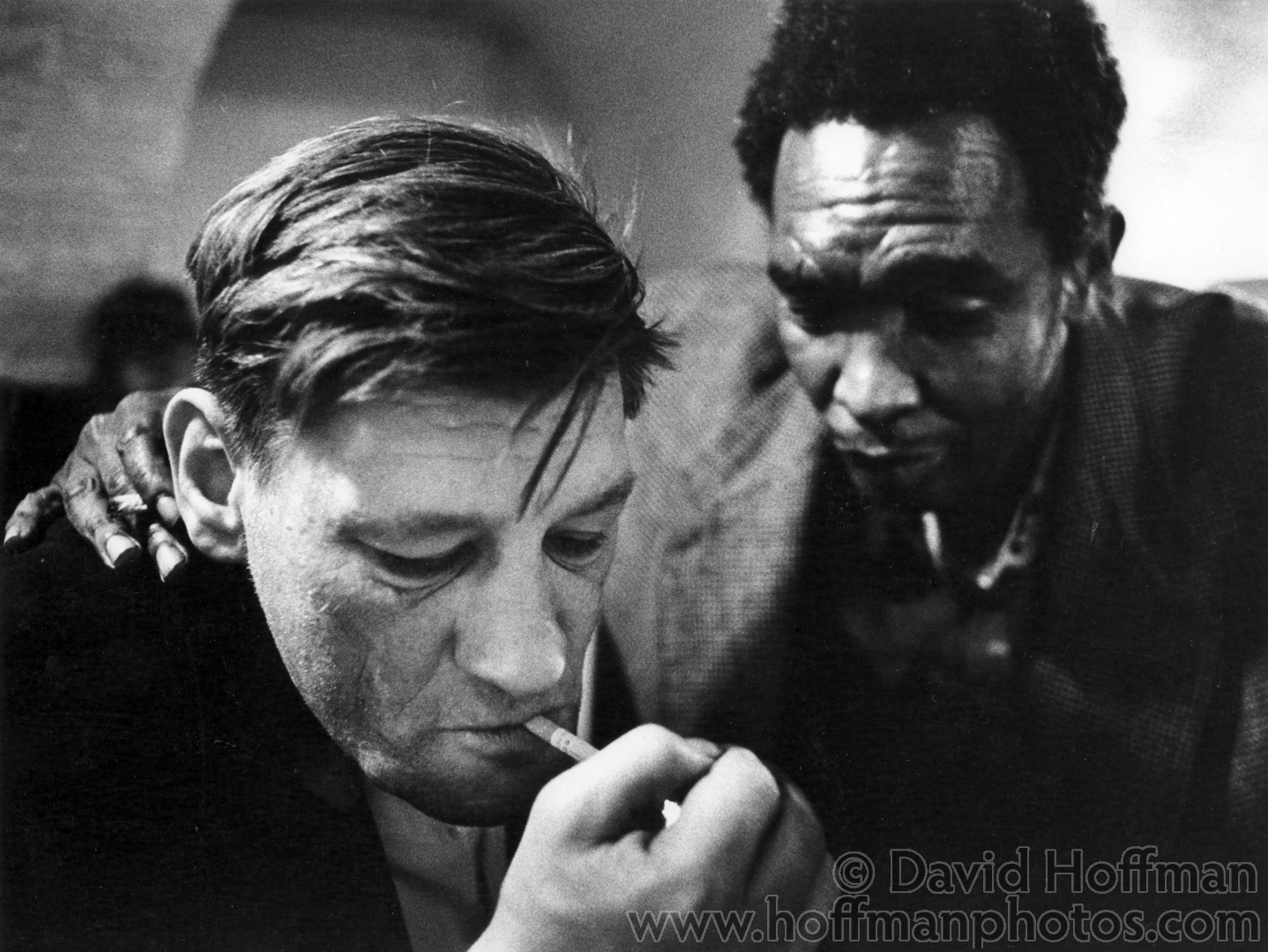
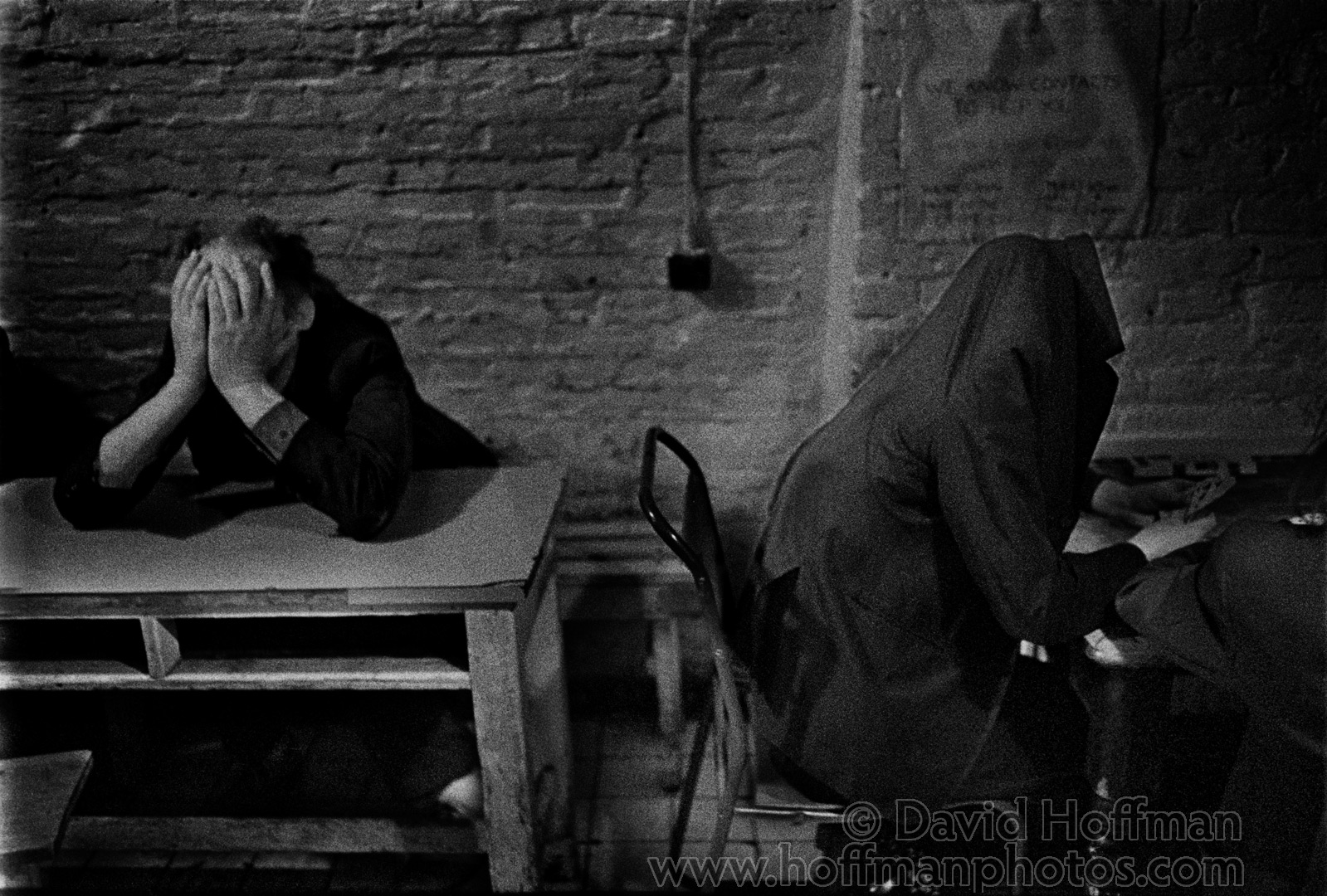
ST BOTOLPH'S CRYPT
As a street photographer I struggle a lot with the question of consent. As a photographer in the first half of the 21st century I feel distrusted. How do you feel about it?
This is very much a 21st century phenomenon and I’m so grateful that I was able to do much of my work before it became a problem.
Like most photographers I deal with it as best I can. I may take pictures quickly and without being noticed. I may hang around so long that people forget about me. I may engage people in conversation so that they understand what I’m doing. I may simply ignore objections or tell people to fuck off and carry on anyway.
Or I may simply not bother with photographing whatever it is. I’ll sometimes photograph something out of support for a cause that I think should be recorded and have images for publicity. I’ll know that my photographs are unlikely to get mainstream publication or make me money but the campaign itself will find the pictures useful and that’s why I go.
If I get a hostile reception I try to explain but if that doesn’t work (people are often too fired up and prejudiced against all media to listen) then sod it. I’ll leave and do something else. Their loss.
ST BOTOLPH'S CRYPT, 1978.
Slideshow of David’s images. (Music: The Adverts – Gary Gilmore’s Eyes)