When you start out as cinematographer, videographer, cameraperson – you know, the human behind the camera – there are few areas as mythical as lighting. Lighting is indeed what sets one DOP apart from another.
Learning about lighting a long and fascinating process and it only keeps you occupied for the rest of your life.
Thinking about lighting before any shoot is a great conceptual exercise with profound practical implications. One of the keys to it is appreciating how the act of photography turns 3D reality into a 2D image, but creating lighting for a 2D image requires thinking in 3D.
Lighting is about volume. That is a given volume of space.
I would like to help you design your lighting by offering to you an extremely simple notion that will nevertheless allow you to structure the way you think about any scene. It’s not the only useful framework to think about lighting, but it is an superbly useful one.
Every lens translates 3D reality into a 2D image. That is the main function of every lens.
With the exception of a 3D movie or a holographic projection we are always looking at a flat image on a flat surface.
What technology has changed in this respect in the past millennia (starting with cave paintings) are the methods artists can employ to create the 2D image.
And now Think ‘Surface’.
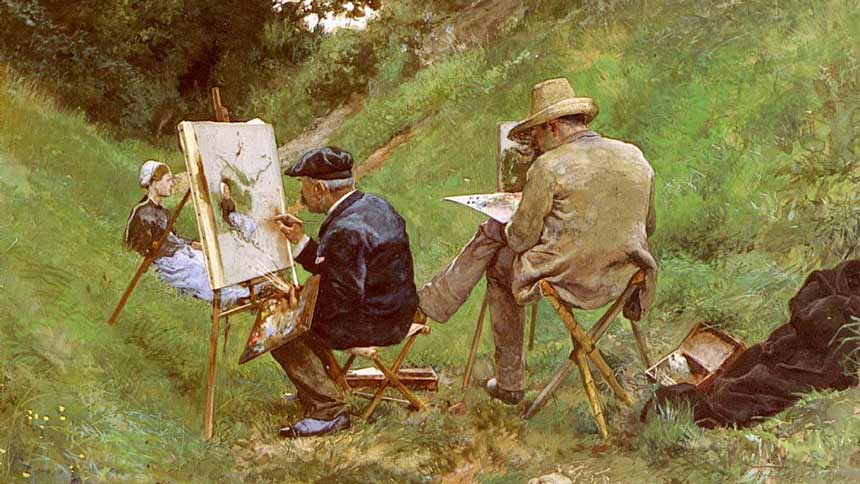
painters use their eyes to turn 3d reality into a flat image.
Perhaps not surprisingly, this activity has – or used to have – the highest prestige. It requires a combination of two skills: seeing and drawing.
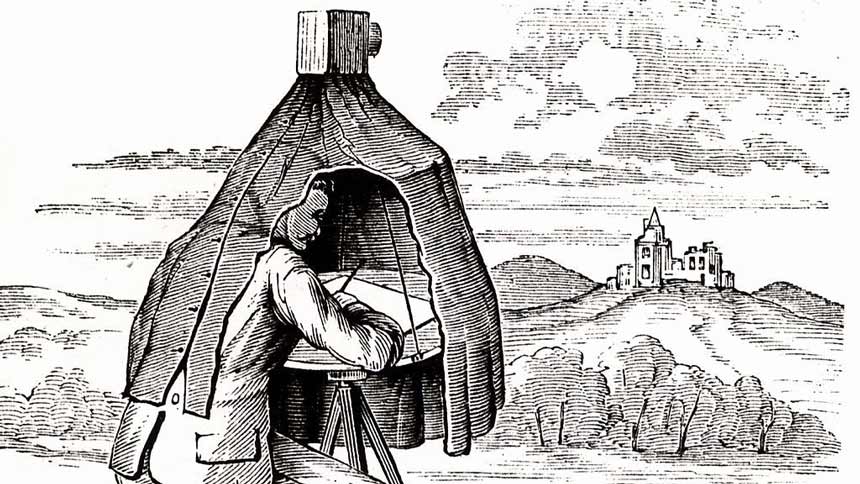
the camera obscura uses a lens to translate 3d into a 2d image.
This was considered ‘cheating’ by many. What is the world coming to when amateurs without skill can do what professionals needed years of training for?
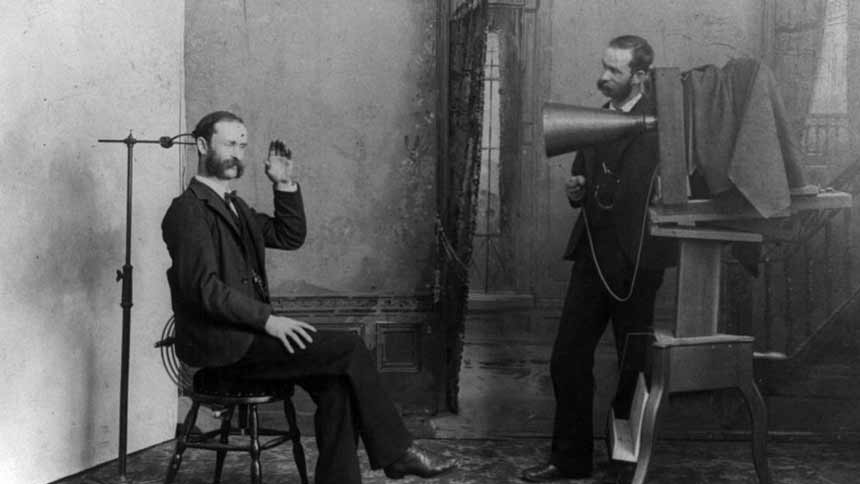
The photographic process uses a lens and records the image.
For the best part of a century after its invention photography was not considered a proper art. It was but a mechanical reproduction of reality.
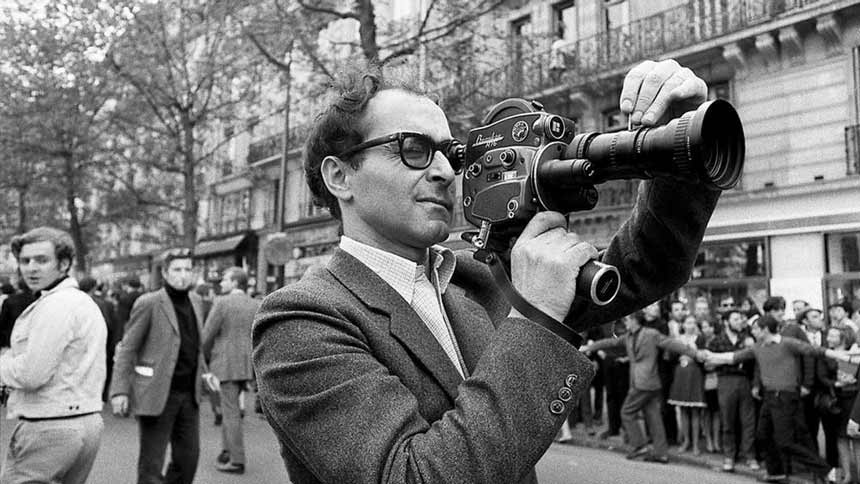
Jean-Luc Godard uses a film camera to record 24 images per second in 1968.
Cinematography ‘only’ changed the number of 2D images created in a second in order to create an illusion of motion when projected.
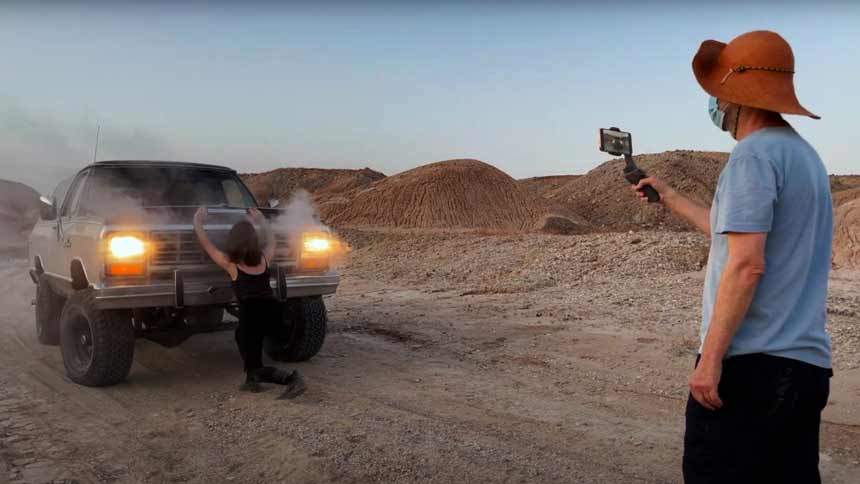
Emmanuel Lubezki uses a very Smart Phone for filming in 2020.
Instead of using a chemical process to create the 3D to 2D translation we overwhelmingly employ a digital one in the 21st century. The recording device got significantly smaller but the underlying principle hasn’t changed.
And back to ‘volume’ again.
your input is a three-dimensional volume.
Assuming that you are working on a non-CGI project you need to think spatially about your lighting. The 2D image you want to create is your goal. To achieve it you need to use your lights in a 3D environment.
The larger your 3D environment is, the more your camera moves or the more angles you are using in a given space, the more light and light sources you’ll need.
This is something you need to fully appreciate – if for no other reason but to be able to explain your lighting budget to your producers and director!
your output is a two-dimensional surface.
This is the beauty, the challenge and the excitement of being a cinematographer. When you are lighting a scene, you shape the 3D world that will get translated into a 2D image.
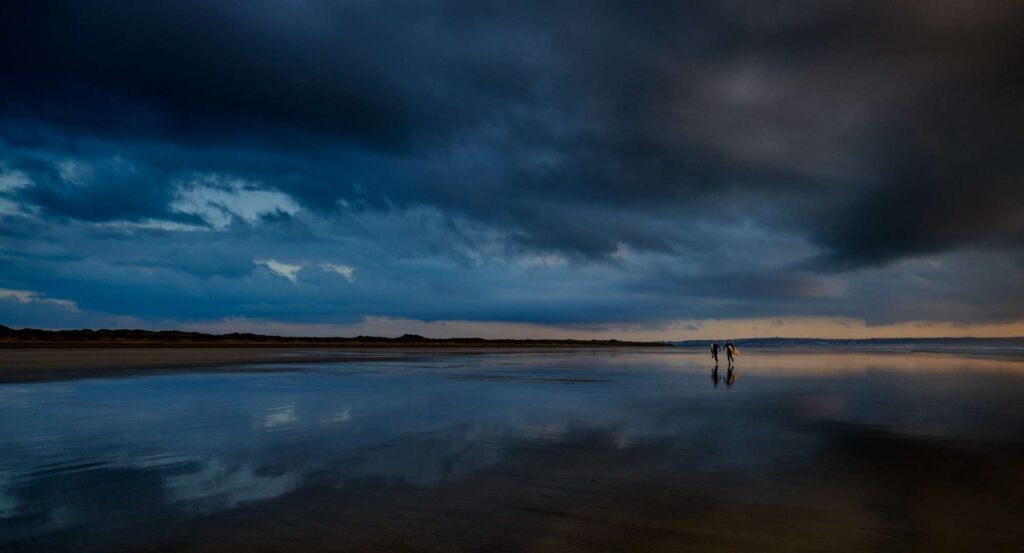
This is an image with 2 light sources.
1. There is the setting sun, a direct light source.
2. Skylight = sunlight diffused through the clouds, the source of the ambient light.
The volume lit up is as far as the eye can see. Could you recreate this with artificial lights? No. The power requirements alone would be, well, astronomical.
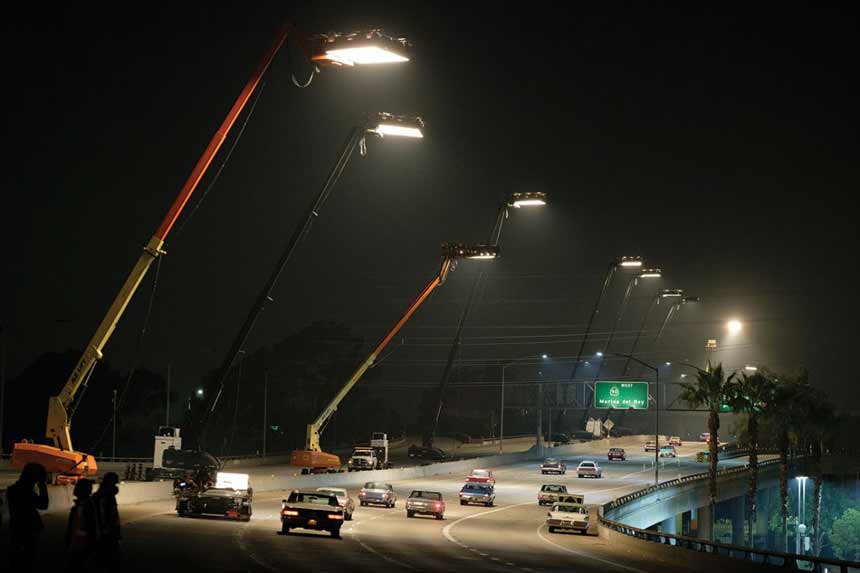
A large-budget nighttime shoot
The stretch of highway is lit up by 8 enormous light sources. This way, the cinematographer can illuminate a space spanning a few hundred meters.
Depending on the speed with which Brad Pitt is driving, this will give you the 20-30 seconds of driving that you need from the shot.
When your camera moves (with or without your subject) space is translated into time. How much space do you need to light up for the planned duration of the shot?
(Source: Once Upon a Time in Hollywood, Dir: Q. Tarantino, 2019)
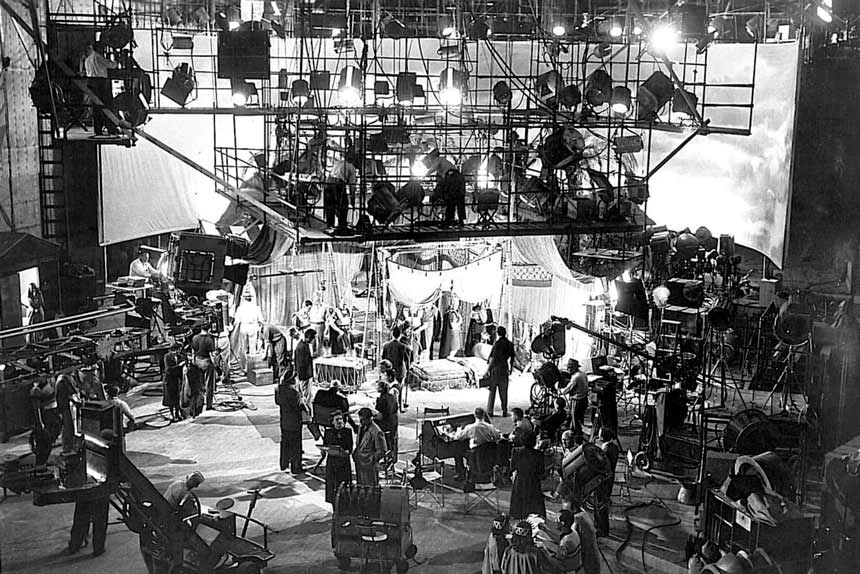
A large-budget studio shoot
Just look at the sheer number of light sources employed to light up the relatively small bedroom set somewhere behind all those people and equipment! Amazing.
Naturally, not all the lights are used for this single set. They are there for any shoot that will take place in the studio. But they are there, to help the cinematographer light up that volume of space.
A very different era, a very different kind of filmmaking.
(Source: Sunset Boulevard, Dir: B. Wilder, 1950)
Nighttime street exterior
This image only shows part of the set built for this part of ‘Roma’. Even so, it’s fascinating to ponder how technology has moved forward when it comes to lighting. Illumination here is provided by a single, powerful cube – a spatial source.
It’s also worth noticing the blue screen in the background. What we see is a set. Large, but still not a real city. Whatever the camera may show from beyond the set will need to be digitally inserted. And blue screen itself needs to be sufficiently lit! Otherwise the keying software will not ‘see’ it.
(Source: Roma, Dir: A. Cuarón, 2018)
Low-budget Nighttime street exterior
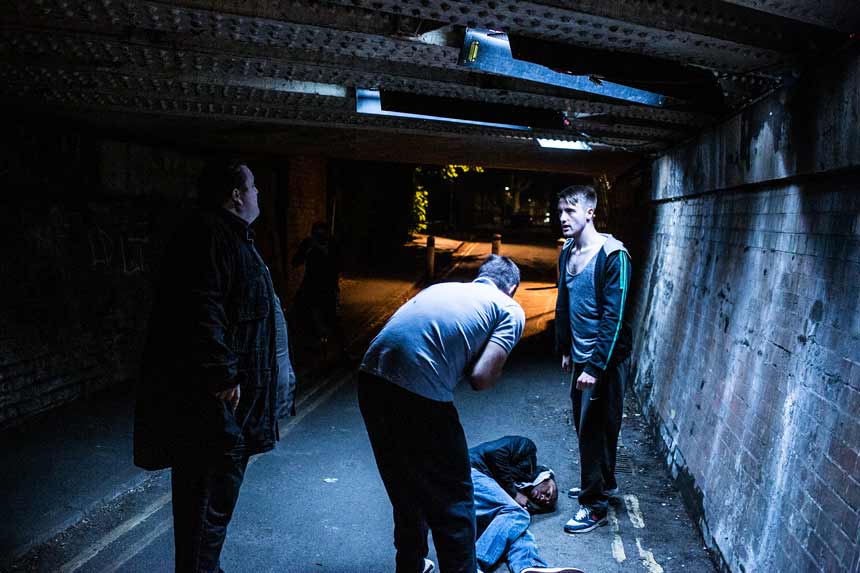
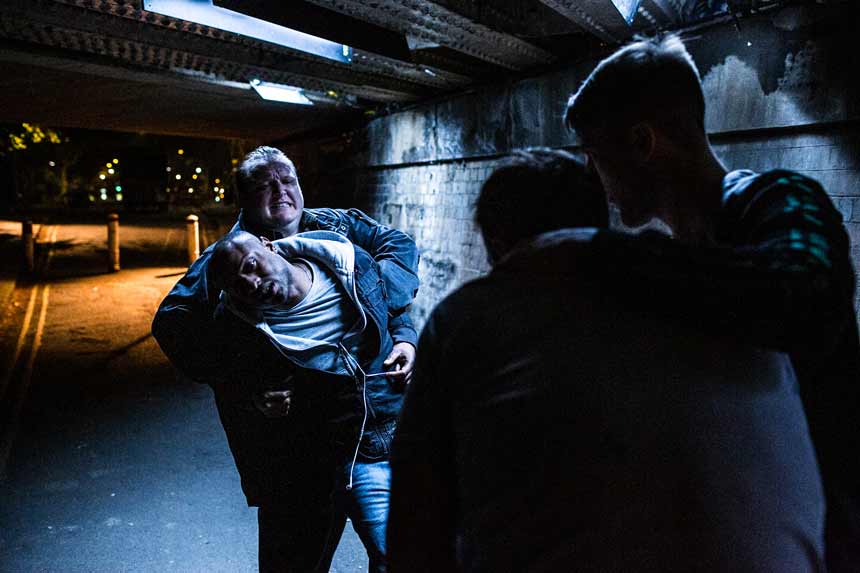
For the action sequence of this indie film we chose an underpass that was easy to light. There are three, light-weight sources installed and two additional lights outside to illuminate part of the background.
This is a high-contrast scene which makes lighting easier to design. As a DOP you don’t need to light up a huge volume. Instead you’re thinking about pockets of light. And since no action takes place in the background, hinting at the effect of a street light is sufficient.
(Source: Stereotype, Dir: J. McGibney, 2014)
Low-budget studio interiors
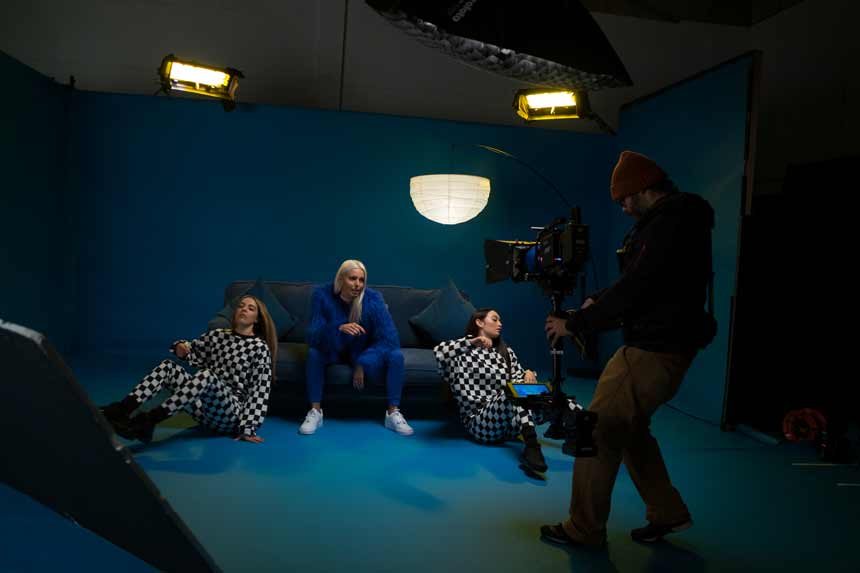
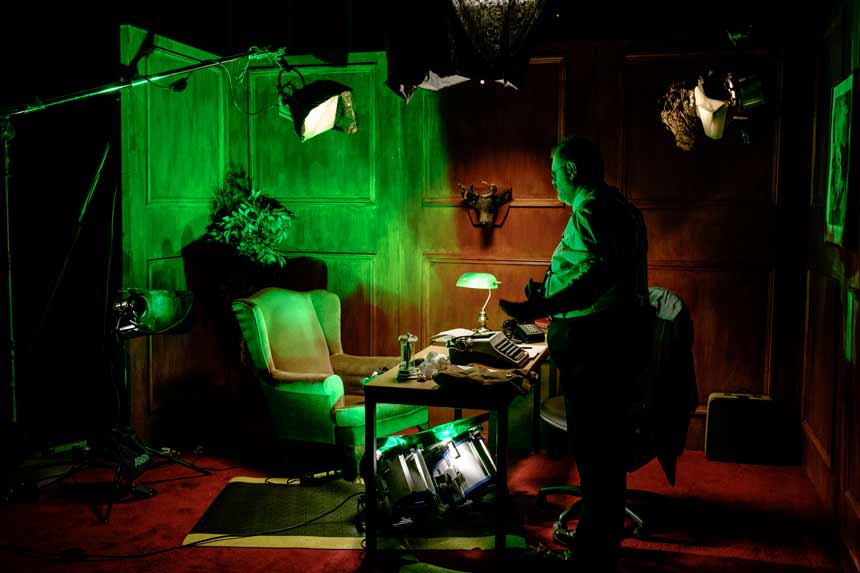
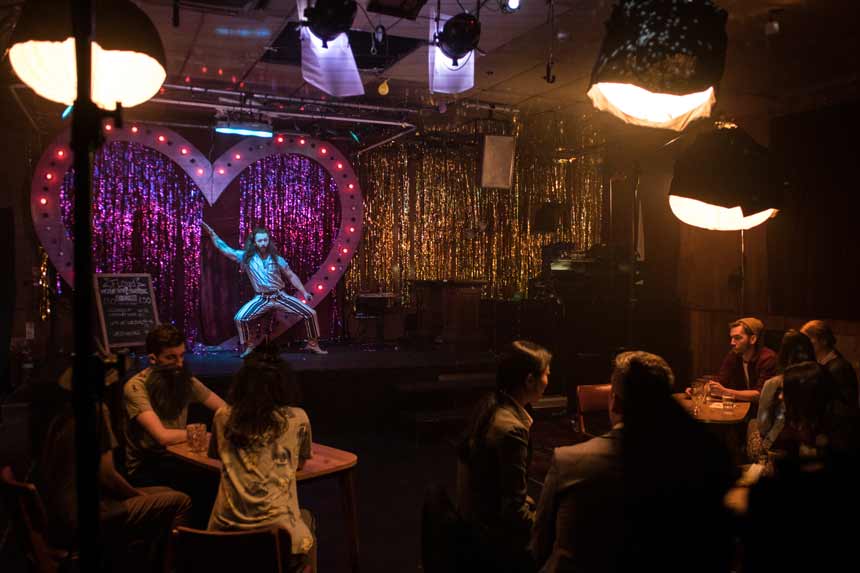
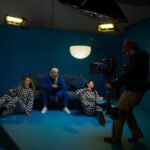
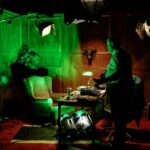
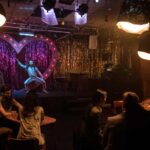
These behind the scenes shots show you how I was thinking about illuminating the volume given to me on these relatively small sets.
First, it’s a music video shoot. Three characters agains a blue background. 3 lights and a reflector was enough the light up the 3 faces occupying the volume of a couch.
The greenish image is a student production on a tiny set. The green lights came on during the shot.
Finally, a stand-up performance. I had two think about lighting two separate volumes: the stage and the audience spaces.
And Now think ‘volume’ and budget and crew size and setup time.
No matter what level your ‘game’ is, as a cinematographer you need to be practical. You need to know your resources before you start painting with light.
Sadly or not, but in filmmaking in all boils down to a single resource, money. Money hires you crew and money buys you the time they will need to build the lighting that you dream about.
Money is always a scarce resource. There is not a single DOP who wouldn’t want another prep day or a few (or many) more lights, generators, cables, gels, frames, stands, cherry-pickers, cranes…
It always boils down to understanding what you need and allocating what’s available to you efficiently. One notion that will help you do that is thinking about your lighting plans in terms of space and volume and not just as the ‘look’ of the final 2D image that you want to create.
If you’d like to watch the above images with a few annotations, here it is.
We use cookies to ensure that we give you the best experience on our website. If you continue to use this site we will assume that you are happy with it.