
The Path to becoming a better photographer
- György
- March 30, 2021
- Photography, Thoughts on…
A well-meaning teacher's Rant to beginners
Dear past, present and future students of mine!
When we study together we have one goal: to set you on a path of becoming a better photographer.
I’m no authority. I simply happen to be someone who is quite good with understanding technology. As it happens, I have taught close to 5000 people – most of them beginners – on my various courses. If nothing else, that has given me an insight into the motivations of beginning photographers and the hurdles facing them.
Shocking as it may sound, the biggest obstacle in your way may just be your digital camera.
the real obstacle: Digital photography is alienating
“Are you mad?” I hear you exclaim. “Digital photography has brought photography closer to tens, hundreds of millions of people!”
True. Relative to just 20 years ago we all have become everyday creators and mass consumers of photos and videos. But as most of that photography and videography is happening on some kind of an automatic mode, you, my dear beginner, have drifted far from understanding how your camera and the lens attached to it work.
Your amazingly clever digital camera has alienated you from photography and has replaced knowledge with “magic”. You push a button, an image appears and you no longer understand what happens in between.
The three kinds of students - which one are you?
Type 1 – The Beginner Who Doesn’t Mind
Understand me well, this is not a value judgement. There are simply tons of people who don’t care about how a photo is born. They don’t feel the need to master photography technically.
There are lots of people who don’t care how a car is built as long as they can drive from A to B. Multitudes couldn’t care less about how wine is produced as long as their tastebuds are happy.
This is fine. You can be a talented, creative photographer who is not interested in how an image comes into existence. I have met accomplished photographers who are shockingly ignorant about the tools that they use. And conversely, there are a huge number of technically accomplished professionals out there producing desperately boring imagery.
It’s healthy to know the limits of how deep you want to get into photography. Images are stories and beautiful stories can be told with the simplest gadgets set on fully automatic modes.
What can I give you if you belong to this group? Creative encouragement, concentrating on issues of composition, learning about matters of light and lighting, colours and black-and-white tones – simply put, improving your story-telling skills. There is a lot of ground we can cover together. The only limitation is that we often hit a brick wall (or a mild rubber wall) when I need to tell you that to move beyond that point, we need to delve into a more technical area.
Type 2 – The Beginner Who Cares and is “Good With Numbers”
Perhaps you are the kind of student who feels strongly that in order to progress you have to master your camera. (I agree with you.) That simply translates into understanding the principles of manual photography. This has nothing to do with being old-fashioned. Not any more than a cookbook insisting that without knowing your ingredients and your oven you cannot start baking.
These are the kinds of students I meet somewhat less often. Why? Because photography is a beautifully simple craft. “You’re mad!” I hear you again. “It takes years, decades of dedication to master it!”
True again. But this applies to any craft. Yet, you can get started with photography after I explain the basics to you in day. Try that with sculpting, painting, playing the guitar, ice-skating or cooking.
The term “good with numbers” applies to people who are okay with basic numeracy.
How is it possible that our societies enforce basic literacy but not numeracy? I don’t know. I just see it happening. Although I am a liberal arts intellectual, I find not knowing the approximate value of √2 or of π no less embarrassing than confusing “theirs” and “there’s”. I believe that understanding that 1/100 is more than 1/200 is just as important as knowing the difference between “see” and “sea”.
Because that is basically all the “math” you need for photography. You have to understand fractions just a little bit. And you have to be able to grasp that quantities in photography tend to double (“the power of 2”).
So, if you meet these criteria, you are the kind of beginner who will read a thin book and then just do it on your own. Get Ansel Adam’s “The Camera” and perhaps “The Negative” and you’ll be done in no time.
What can I give these students? First, there is always room for technical improvement, elaborating on advanced points and making sure that you know not only random bits and bobs but also grasp the knowledge framework of photography. Second, hurray, let’s get going and work on your powers of imagination and creativity.
Type 3 – The Beginner Who Cares and is “Bad With Numbers”
In my line of work these are the photographers I meet the most often. You’re ambitious enough to want to improve but you realise that you need a teacher and not a book to help you along your path.
(I have been cycling since I was 4 but I very much need the help of my friend, a semi-professional racer to motivate me to train better and harder.)
If you’re not so great with numbers, you simply have to get better with them. And the key to that is either giving up digital photography for a month or two (is that really that much to ask?) or to treat your digital camera as much as possible as an old-fashioned analogue camera.
Why?
Your digital camera alienates you from photography. If you’re a Type 1 student your gear overwhelms you. It seems so complicated that you only use it in the fully automatic mode. Or you’re a Type 2 and you start mistaking technical competence for being a good (better) photographer.
the solution
Option 1 – Get an analogue camera
For less than £200, sometimes for well under £100, you can find beautiful film cameras on Ebay. Machines that as child I was dreaming about! Nikon, Canon, Minolta, Pentax, Olympus, Leica – there are thousands of amazing, perfectly functional manual cameras waiting for you with a trusty 50mm prime lens on it.
Get 10 rolls of black-and-white and 10 rolls of colour film. That will give you around 700 photos.
How will an analogue camera help you?
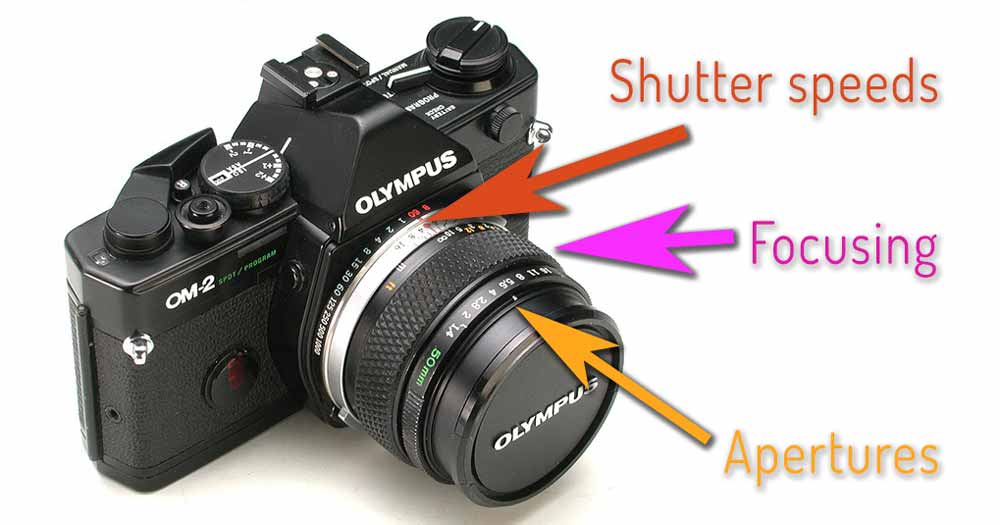
It will force you to set your aperture and shutter speed manually. You will look at the numbers and learn them. You won’t be flooded by dozens of “in-between” numbers that digital cameras use, there will be no 15-page menu system to understand. Once you put your film in your camera (that will be your ISO for the rest of the roll) you can only set one of your 8-10 shutter speeds and one of your 6-8 apertures.
That plus your little, built-in light meter’s needle and you are done.
And since your lens will be a manual lens, you will understand what focusing actually means.
Look at this beautiful Olympus om-2. So, so simple!
Option 2 – Treat Your Digital Camera as an Analogue One
Okay, so you’re impatient and don’t believe me that an analogue camera is the best way forward. No problem. Then you must start treating your digital one in a new way.
How? You must train yourself not to look at the back display while you’re shooting. Turn it off completely. If it can be folded in (like on many Canon DSLRs), do that. If your camera has a secondary top LCD display with settings don’t look at that either. Use only your viewfinder.
Train your eye to look at the numbers there before you take a picture. You also have to train your fingers to adjust aperture, shutter speed and ISO without looking. (Like shifting gears in a car – you simply cannot look at the hand, right? It must know where it is.)
Now observing your subject (paying attention to composition and framing) as well as seeing your settings (the numbers) inside your viewfinder, set your exposure. Look at your light meter and before you push the shutter release take a mental note of the numbers.
If possible, use only the standard, “old-fashioned” numbers: the traditional, full stops. If you don’t know them, have a look at them here.
As for understanding focusing, that will be a bit more difficult. You can always turn off AF, but focusing manually and precisely with a modern photographic lens using just your optical or electronic viewfinder is extremely difficult.
This path is a bit more complicated than Option 1. Working with an analogue camera is “pure” by necessity: there is nothing else you can do with those cameras. Treating your digital marvel as an analogue gadget is more difficult because you have to force yourself to ignore all the great tools, buttons, dials and menu options that you camera offers.


